Texas small claims court, explained accurately
Texas Small Claims and Justice Court Help
Start with the phrase people search for, then get the Texas-specific details right: small claims, debt claims, repair and remedy, evictions, forms, fees, deadlines, and county variation.

26
task pages
10
priority counties
65
official links checked
Legal information only: This site provides legal information for Texas Justice Court users. It is not legal advice, does not create an attorney-client relationship, and does not replace advice from a licensed Texas attorney or instructions from your court. County and precinct practices vary. Filing methods, local forms, service fees, court closures, and clerk procedures can change. Always verify details with the correct Justice of the Peace court before filing or relying on a deadline.
Small claims is only one Justice Court case type
Texas Justice Court is not one single kind of case. A general money or property dispute may be small claims. A collection lawsuit may be a debt claim. A residential tenant repair problem may be repair and remedy. A landlord seeking possession uses eviction procedure.
Case type first
Choose the closest starting point
These cards describe common Justice Court lanes. They are not legal conclusions. Verify the case type and local form with the correct JP court.
Small claims
JP courtA general Justice Court civil case for money damages, civil penalties, personal property, or other relief allowed by law.
Generally up to $20,000, excluding statutory interest and court costs but including attorney fees if any.
Debt claims
JP courtA Justice Court case to recover a debt brought by a debt buyer, assignee, collection agency, financial institution, or person/entity primarily engaged in lending money at interest.
Generally up to $20,000, excluding statutory interest and court costs but including attorney fees if any.
Repair and remedy
JP courtA fast-track case for a residential tenant asking the court to enforce a landlord repair duty for conditions that materially affect physical health or safety.
Justice Court relief is capped at $20,000 excluding interest and court costs, including any repair order value.
Evictions
JP courtA separate Justice Court lane for recovering possession of real property. Rent can be joined only within the Justice Court rent limit.
Possession is the main issue. Rent may be joined if the unpaid rent claim is not more than $20,000, excluding statutory interest and costs but including attorney fees if any.
Workflows
Task-based help
The site is organized around the things people need to do: identify the case type, find the right court, file or answer, prepare for trial, understand judgment and appeal, and verify county-specific details.
Templates & kits
Court-aware documents, ready to edit
The guides are free. When you need the paperwork — demand letters, hearing prep worksheets, landlord forms, or the complete starter kit — each kit is a one-time purchase delivered instantly as editable DOCX plus printable PDF.

Demand Letter Pack
$19Four Texas-specific demand letters plus sending instructions.
5 documents · DOCX + PDF
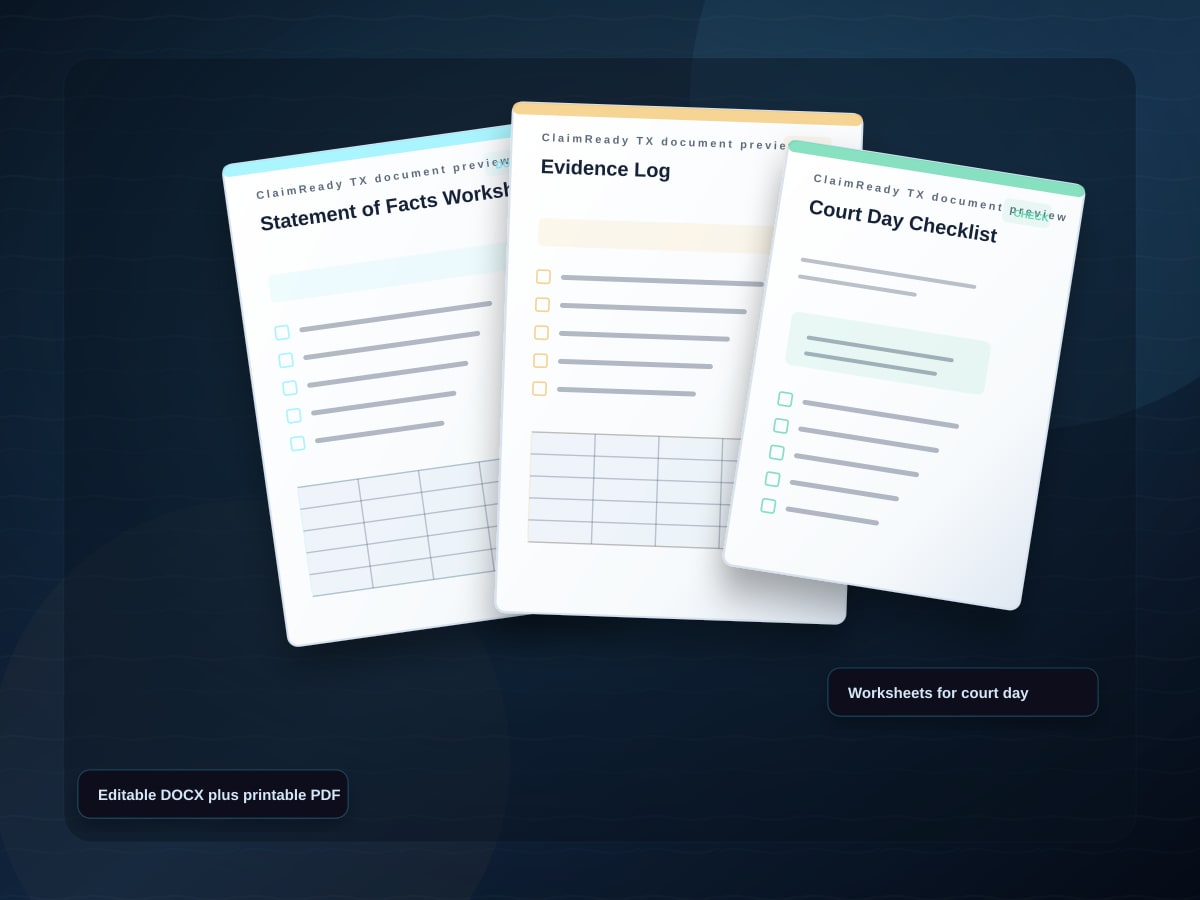
Hearing Prep Pack
$19Walk into your JP court hearing organized, not overwhelmed.
6 documents · DOCX + PDF
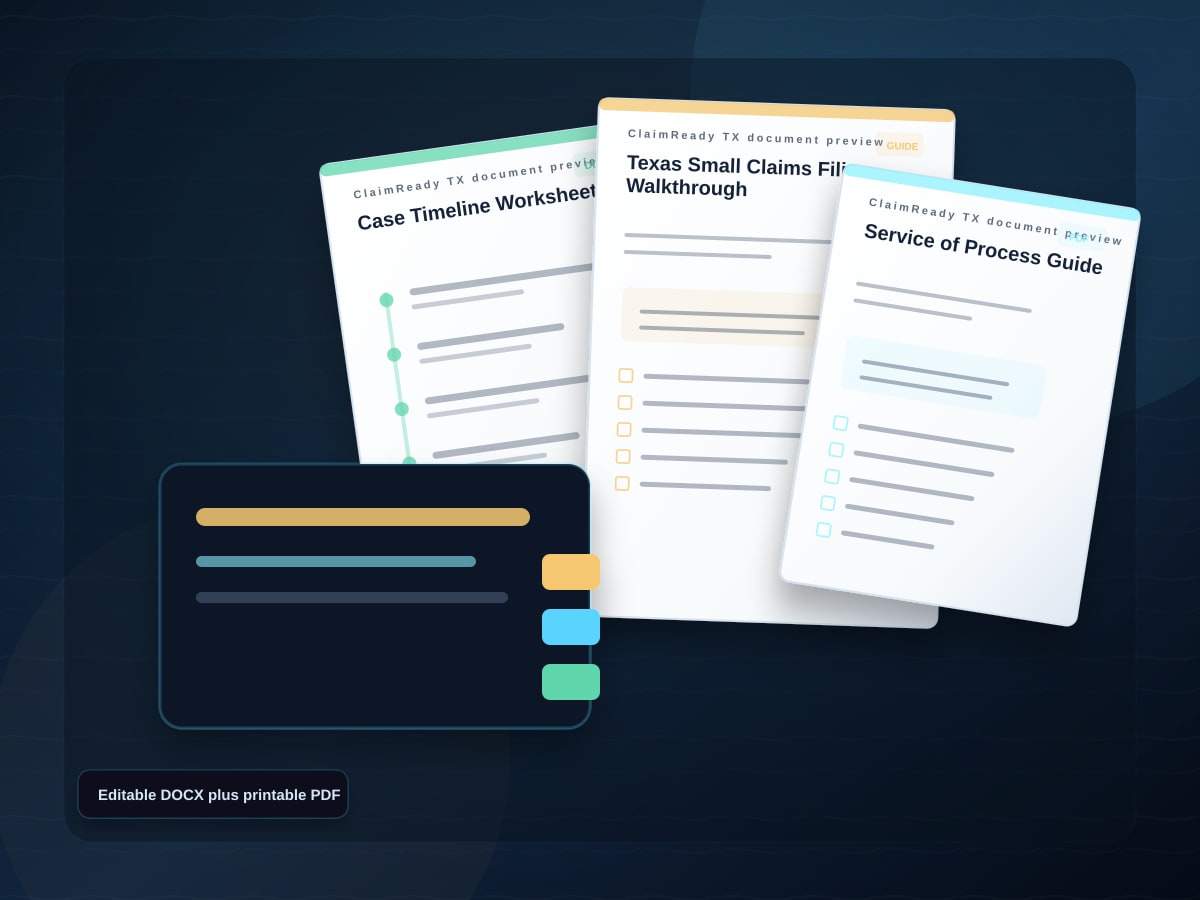
Full Texas Small Claims Starter Kit
$49Every template and guide, from first demand letter to collecting a judgment.
17 documents · DOCX + PDF
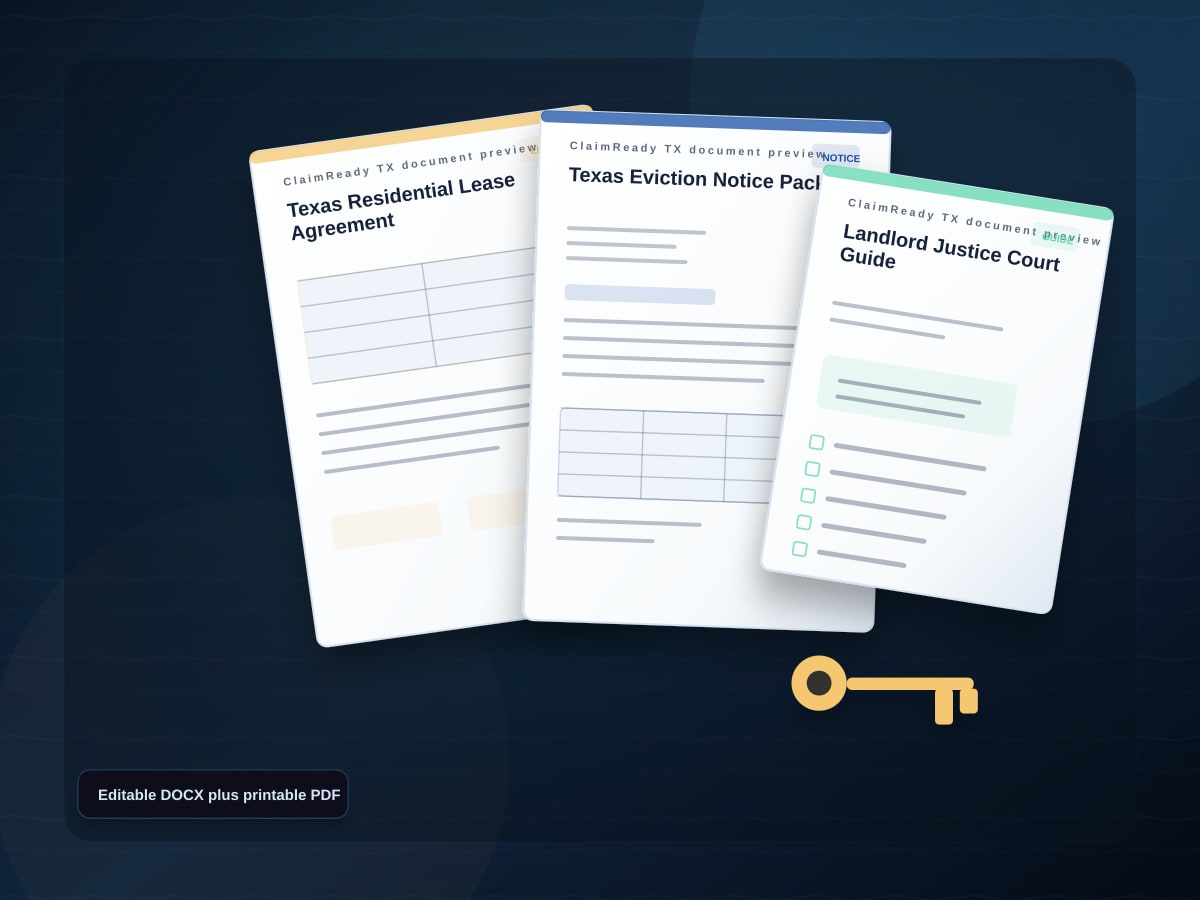
Texas Landlord Forms Pack
$29Leases, notices, and a Justice Court guide for Texas landlords.
4 documents · DOCX + PDF
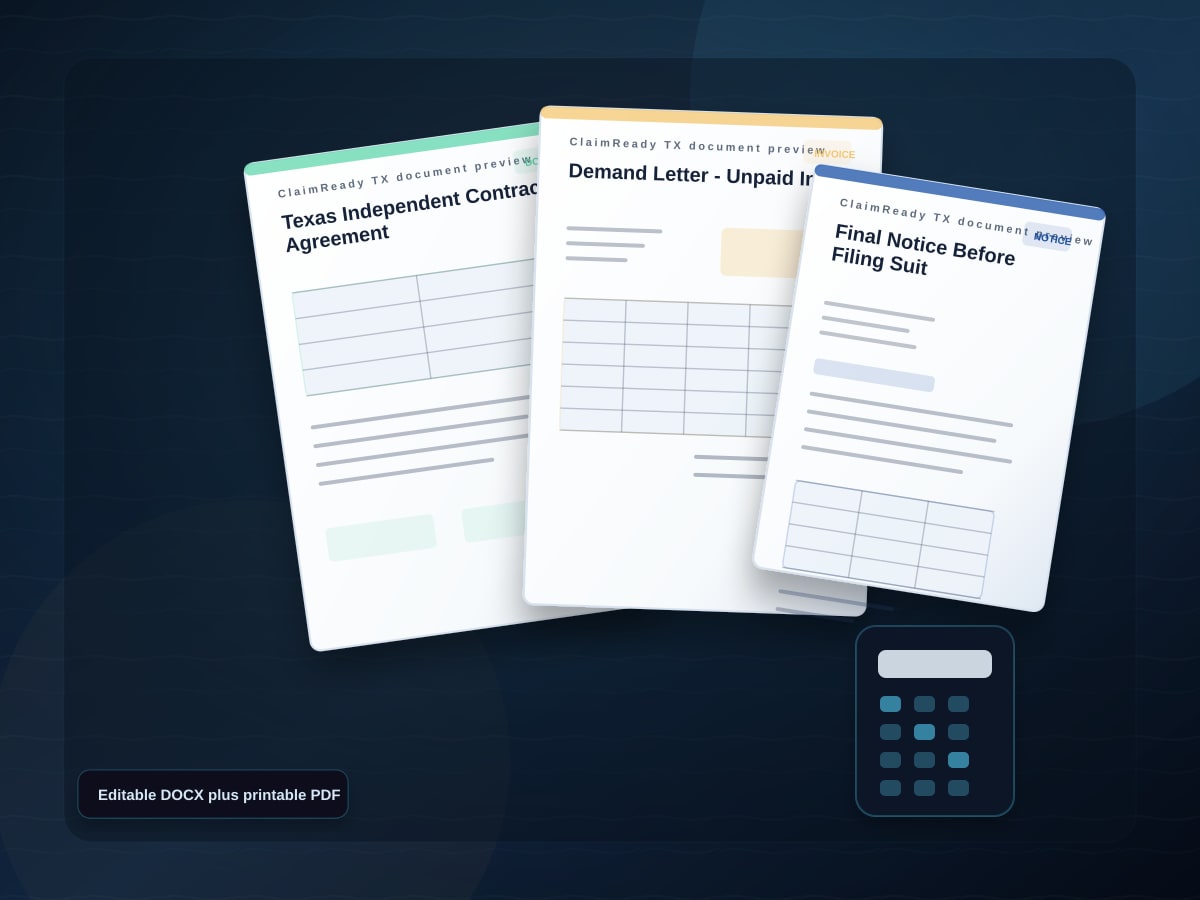
Texas Small Business Collections Pack
$24Get paid: contracts, escalating demand letters, and a guide to suing a business.
4 documents · DOCX + PDF
Browse all templates & kits, plus a free demand letter →Verify before relying
Deadlines at a glance
These are baseline rules from statewide and self-help sources. The calculators and tables are estimates. Court papers, court closures, and local instructions can control.
| Event | Baseline Rule | Verification Warning |
|---|---|---|
| Answer in non-eviction Justice Court case | Generally 14 days after service. | If the court is closed on the due date, verify the next-open-day rule with the court. |
| Answer in eviction case | Check the eviction citation and trial setting. Senate Bill 38 changed eviction answer and hearing procedure effective January 1, 2026 — follow the instructions on the citation rather than a generic rule. | Evictions move quickly. Do not rely on a generic day count. |
| Jury request in non-eviction Justice Court case | Generally at least 14 days before trial, with a $22 fee unless costs are waived. | Local forms and fee-waiver handling vary. Confirm with the court. |
| Jury request in eviction case | Ask the court handling the eviction how and when to request a jury. Senate Bill 38 changed eviction answer and hearing procedure effective January 1, 2026, and some cases can be decided by summary disposition before any trial setting — do not rely on a pre-2026 day count. | Verify the exact deadline, the $22 fee unless costs are waived, and the filing method with the court handling the eviction. |
| Appeal from non-eviction Justice Court judgment | Generally 21 days from the signed judgment, or from denial of a timely post-judgment motion. | Post-judgment motions can affect timing. Verify before relying on a deadline. |
| Appeal from eviction judgment | Generally 5 days after the Justice Court signs the eviction judgment. | Missing this deadline can be case-ending. Registry-rent deadlines may also apply. |
| First registry rent payment after eviction appeal | In a nonpayment-of-rent eviction, a tenant who appeals by Statement of Inability to Afford Payment of Court Costs and wants to stay in the home generally must pay one rental period of rent into the court registry within 5 days of filing the Statement. | The judgment and appeal paperwork specify whether registry rent applies to you and the exact amount. Verify immediately. |
| Motion to set aside default / motion for new trial tracking | Generally 14 days after the judgment is signed, under Texas Rule of Civil Procedure 505.3. | Post-judgment timing is high-risk. Verify the rule and your judgment date with the court. |
Local court controls
County details matter
Texas counties and precincts differ on forms, e-filing, service fees, precinct lookup tools, default packages, and local instructions. Every county-specific item on this site has a source URL, a last-reviewed field, and a verification warning.
Priority county directory
Travis, Williamson, Hays, Dallas, Harris, Bexar, Tarrant, El Paso, Collin, and Denton are included in the first version.
Open county directoryCommon questions
Quick answers before you start
Is small claims court the same as Justice Court in Texas?
People often search for small claims court, but Texas civil small claims are handled in Justice Court. Justice Court also handles debt claims, repair and remedy cases, and evictions.
Can this site tell me what to file?
No. This site provides legal information and source links. It can explain common case-type signals, but users must verify forms, deadlines, fees, and venue with the correct Justice of the Peace court or a licensed Texas attorney.
Do Texas Justice Court fees vary by county?
Yes. A common statewide filing-fee structure starts at $54, but service fees and local procedures vary by county and sometimes by precinct.